Suggested meta description: Explore how online learning resources, digital education tools, and educational technology are transforming classrooms and unlocking powerful e-learning benefits for students at Vikas The Concept School.
Not long ago, a student's access to knowledge was limited by the size of the school library and the hours in a teacher's day. Today, a single tap opens the door to virtual laboratories, interactive lessons, expert lectures, and a world of information that never closes. The shift has been quiet but profound and it is reshaping what learning can look like for every child.
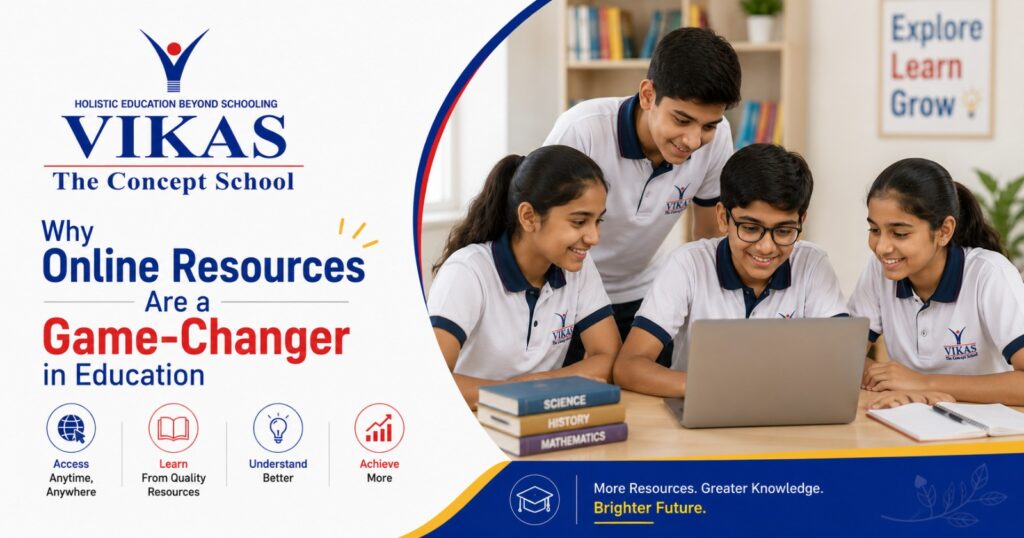
At Vikas The Concept School, we have always believed that education should reach beyond the four walls of a classroom. Online resources have turned that belief into everyday reality, giving students the freedom to explore, revise, and discover at their own pace. They are not a replacement for great teaching; they are a powerful extension of it.
The Rise of Online Learning Resources
Online learning resources are digital materials and platforms that support teaching and learning video lessons, e-books, practice quizzes, virtual labs, educational apps, recorded lectures, and collaborative tools, to name just a few. What once required a physical textbook or a fixed timetable can now be accessed anytime, from anywhere.
This accessibility is exactly what makes these resources so transformative. A student who missed a concept in class can rewatch an explanation at home. A curious learner can dive deeper into a topic long after the lesson has ended. And a teacher can curate the very best material from across the world to enrich a single lesson. Learning becomes continuous rather than confined to school hours.
How Digital Education Tools Are Changing the Classroom
Digital education tools have redefined the way knowledge is delivered and absorbed. Interactive whiteboards bring diagrams to life, simulations let students conduct experiments safely, and adaptive learning apps adjust difficulty based on each child's progress.
The biggest change is the shift from passive listening to active participation. Instead of simply receiving information, students engage with it — dragging, clicking, solving, and creating. This hands-on involvement deepens understanding and makes lessons far more memorable.
Digital tools also support different kinds of learners. A visual learner thrives on infographics and videos, an auditory learner benefits from podcasts and recorded explanations, and a kinaesthetic learner enjoys interactive simulations. By offering multiple ways to engage with the same concept, technology helps ensure that no child is left behind.
The Real E-Learning Benefits for Students
The advantages of e-learning go well beyond convenience. When used thoughtfully, online resources unlock benefits that traditional methods alone cannot match.
Personalised pace. Every child learns differently. E-learning allows students to slow down on difficult topics and move quickly through familiar ones, building genuine mastery instead of rushing to keep up.
Anytime revision. With recorded lessons and digital notes always available, students can revise whenever they need to before an exam, during a holiday, or simply when curiosity strikes.
A world of information. Online platforms expose students to ideas, cultures, and perspectives far beyond their immediate surroundings, broadening their thinking and sparking new interests.
Instant feedback. Many digital tools assess answers in real time, helping students identify and correct mistakes immediately rather than waiting days for a graded paper.
Building independence. Navigating online resources teaches students to research, evaluate sources, and take ownership of their own learning — skills that prove invaluable in higher education and beyond.
Educational Technology and the Future of Learning
Educational technology is no longer a luxury or an add-on; it is becoming the backbone of modern education. From virtual classrooms that connect students across distances to artificial-intelligence tools that personalise practice, technology is expanding what is possible in teaching and learning.
Importantly, educational technology also prepares students for the world they will inherit. The careers of tomorrow will demand digital fluency, adaptability, and comfort with new tools. By integrating technology into everyday learning, schools equip children with the confidence and competence to thrive in a digital-first future.
At the same time, the goal is never technology for its own sake. The most effective learning happens when digital tools work hand in hand with skilled, caring teachers who guide students, contextualise information, and nurture the human qualities that no screen can replace.
Making the Most of Online Resources
To truly benefit from online learning, students and families can keep a few simple principles in mind:
Choose quality over quantity. A few trusted, well-designed platforms are far more valuable than an endless scroll of random content.
Balance screen time. Online resources are most effective in healthy doses, balanced with reading, hands-on activities, play, and rest.
Stay curious, stay safe. Encouraging children to explore responsibly while teaching them to evaluate sources and protect their privacy turns the internet into a powerful learning companion.
Blend the digital with the personal. The best outcomes come from combining online tools with classroom discussion, teacher guidance, and peer collaboration.
Learning Without Limits
Online resources have removed the boundaries that once defined education. They have made learning more flexible, more inclusive, and more engaging than ever before. With the right blend of online learning resources, digital education tools, and educational technology, students gain not just knowledge, but the skills and confidence to keep learning for life.
At Vikas The Concept School, we embrace this digital evolution while staying true to our core philosophy of holistic education. Technology helps us personalise learning, spark curiosity, and prepare our students for a fast-changing world but it is our teachers, values, and community that give that learning meaning.
Because in the end, the goal of education has never changed. We simply have more powerful tools than ever to achieve it.