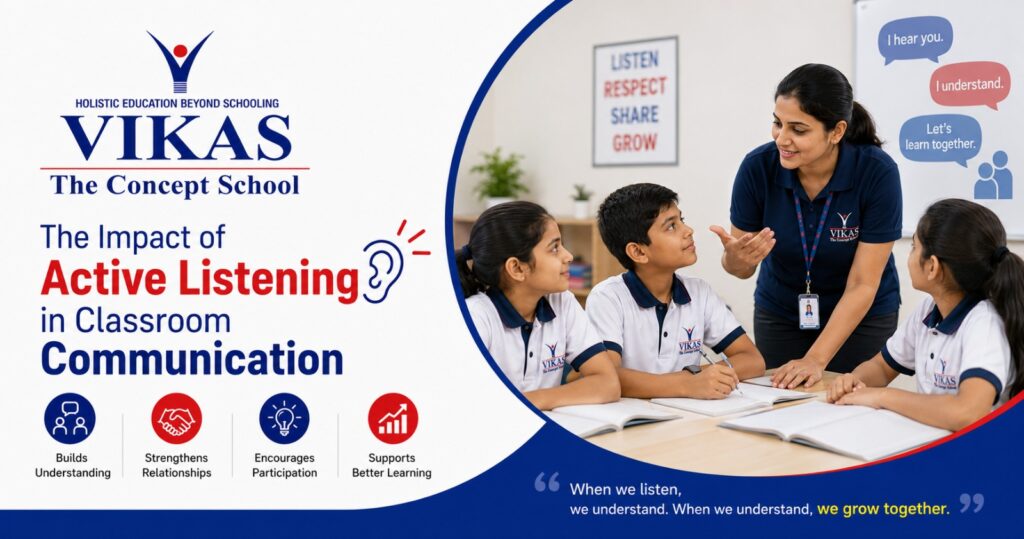
Discover how active listening transforms classroom communication, strengthens student–teacher interaction, and builds an effective learning environment at Vikas The Concept School.
Walk into any thriving classroom and you will notice something that has nothing to do with textbooks, smartboards, or syllabi. You will notice attention — students leaning in, a teacher pausing to truly hear a question, ideas bouncing back and forth with genuine understanding. That quiet, powerful exchange has a name: active listening. It is one of the most underrated yet transformative skills in education, and it sits at the very heart of meaningful classroom communication.
At Vikas The Concept School, we believe learning is never a one-way street. It is a conversation. And like every good conversation, it depends on how well we listen.
What Is Active Listening?
Active listening is far more than staying silent while someone else speaks. It is the deliberate practice of fully concentrating on a speaker, understanding their message, responding thoughtfully, and remembering what was shared. In a classroom, this means a teacher who hears not just the words a student says but the confusion, curiosity, or confidence behind them — and a student who absorbs a lesson rather than simply waiting for their turn to talk.
Active listening in education involves several skills working together: maintaining eye contact, observing body language, asking clarifying questions, paraphrasing to confirm understanding, and withholding judgement until the speaker has finished. When these habits become second nature, the entire classroom dynamic shifts.
Why Active Listening Matters in the Classroom
Strong classroom communication skills are built on a foundation of listening. When teachers model and encourage active listening, the benefits ripple across every part of school life.
It improves comprehension. Students who listen actively process information more deeply. Instead of memorising for a test, they connect ideas, ask better questions, and retain concepts long after the lesson ends.
It strengthens student–teacher interaction. A teacher who listens attentively signals that every voice matters. This encourages even hesitant students to participate, share doubts, and take intellectual risks without fear of being dismissed.
It reduces misunderstandings. Many classroom conflicts and learning gaps come down to miscommunication. Active listening helps clarify instructions, expectations, and feedback before small confusions grow into bigger obstacles.
It builds emotional safety. When children feel heard, they feel valued. That sense of belonging is essential for confidence, motivation, and wellbeing — all of which directly influence academic performance.
Active Listening and Student–Teacher Interaction
The relationship between a student and a teacher is one of the most influential factors in a child's educational journey. Active listening is the thread that holds this relationship together.
When a teacher genuinely listens, they can tailor their teaching to the needs in front of them. They notice when a concept hasn't landed, when a student is struggling silently, or when a moment of curiosity deserves to be explored further. This responsiveness turns a standard lesson into a personalised learning experience.
Equally important, students learn by example. When they see their teachers listening with patience and respect, they begin to mirror those habits with their peers. Group discussions become richer, collaborative projects run more smoothly, and the classroom transforms into a community of mutual respect rather than a room of competing voices.
How Active Listening Creates an Effective Learning Environment
An effective learning environment is not defined by infrastructure alone — it is defined by the quality of communication within it. Active listening is the invisible architecture that makes such an environment possible.
In classrooms where listening is prioritised, students feel comfortable expressing ideas, debating respectfully, and learning from one another's perspectives. Diversity of thought becomes a strength rather than a source of friction. Teachers, in turn, gain valuable insight into how their students think, allowing them to adjust pace, revisit difficult topics, and celebrate progress meaningfully.
This culture of attentive communication also nurtures critical life skills. Children who learn to listen well grow into adults who collaborate effectively, resolve conflicts with empathy, and lead with understanding — qualities that matter far beyond the classroom walls.
Practical Ways to Encourage Active Listening
Active listening can be taught, practised, and strengthened over time. A few simple strategies make a noticeable difference:
Create a distraction-free space. Minimising background noise and interruptions helps both teachers and students focus fully on the speaker.
Use the pause. Encouraging a brief pause before responding gives students time to process information and frame thoughtful replies rather than rushing to answer.
Ask reflective questions. Prompts like "What do you think she meant by that?" or "Can you explain it in your own words?" reinforce the habit of listening to understand, not just to respond.
Practise paraphrasing. Teaching students to restate what a classmate said before adding their own view ensures everyone feels genuinely heard.
Encourage non-verbal cues. Nodding, eye contact, and open body language all show a speaker that their words are being received with respect.
Make listening a shared value. When a school community treats listening as a core expectation — in classrooms, assemblies, and conversations alike — it becomes a natural part of how everyone communicates.
Listening: The Skill That Shapes Lifelong Learners
In a world overflowing with information and noise, the ability to listen with intention is rarer — and more valuable than ever. Active listening sharpens academic performance, deepens student teacher interaction, and lays the groundwork for an effective learning environment where every child can flourish.
At Vikas The Concept School, we see active listening not as a classroom rule but as a way of life. It reflects our belief that education is most powerful when it is built on understanding, empathy, and genuine human connection. When we teach our students to listen well, we are not just helping them succeed in examinations we are preparing them to become thoughtful communicators, compassionate collaborators, and confident leaders of tomorrow.
Because true learning begins the moment we choose to listen.