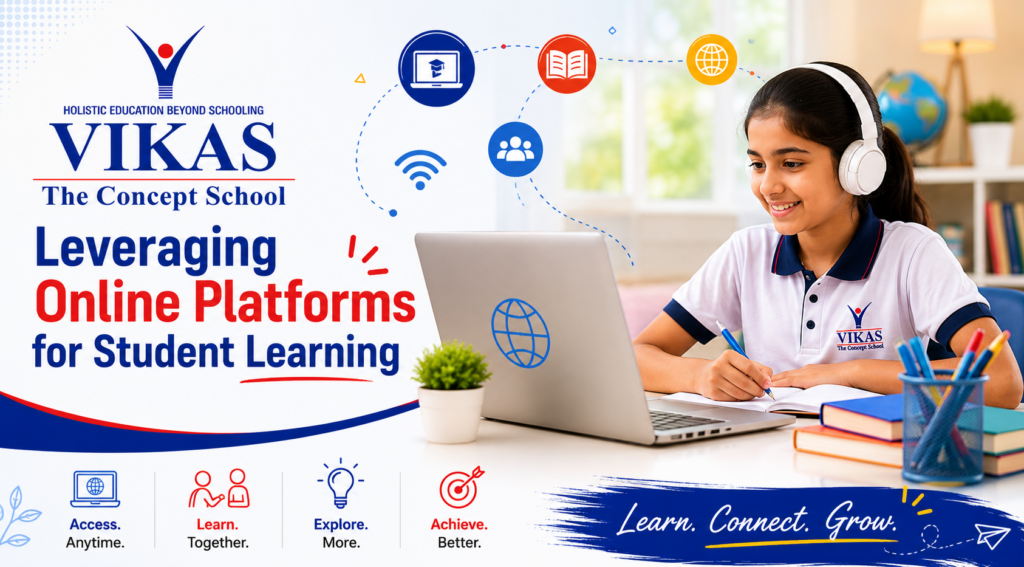
Not long ago, learning was confined almost entirely to the four walls of a classroom and the pages of a textbook. Today, a child can explore a virtual model of the solar system, revisit a difficult lesson at their own pace, collaborate on a project with classmates from home, or get instant feedback on their work — all through a screen. The rise of online learning platforms has opened up powerful new possibilities for how students learn.
At Vikas the Concept School, Hyderabad, we see technology not as a replacement for great teaching, but as a powerful partner to it. Used thoughtfully, online platforms can deepen understanding, personalise learning, and prepare students for a digital world. Here is how schools and parents can make the most of them.
The Promise of Online Learning Platforms
Online learning platforms bring several distinct advantages to a child's education. They make learning more flexible, allowing students to revisit lessons, learn at their own pace, and access material whenever and wherever they need it.
They also expand what is possible inside a lesson. A well-chosen platform can turn an abstract concept into an interactive simulation, transform practice into a game, or connect a classroom in Hyderabad to ideas and people across the world. For students who grasp concepts at different speeds, this flexibility can be the difference between frustration and genuine understanding.
Digital Education Tools That Enhance Learning
The range of digital education tools available today is remarkable. Interactive videos and animations bring difficult topics to life. Adaptive practice programmes adjust to each child's level, offering the right challenge at the right time. Collaborative documents let students work together in real time, while quizzes and instant-feedback tools help both students and teachers see exactly where understanding is strong and where it needs reinforcing.
The value of these tools lies not in their novelty, but in how they are used. The best digital education tools do not simply digitise old worksheets — they enable forms of learning that were difficult or impossible before: visualising, experimenting, creating, and receiving immediate feedback.
Making E-Learning for Students Effective
E-learning for students works best when it is purposeful rather than passive. Watching endless videos is not the same as learning. Effective e-learning engages children actively — asking them to solve problems, create something, reflect, or apply what they have learned.
A few principles make a real difference. Learning goals should be clear, so technology serves a purpose rather than becoming a distraction. Content should be interactive, not just something to watch. And progress should be visible, so students stay motivated and teachers can offer timely support. When these elements come together, e-learning becomes a genuine driver of understanding, not merely screen time.
The Rise of Virtual Classroom Learning
Virtual classroom learning — where teachers and students connect in real time through a digital space — has become an established part of modern education. It enables live teaching, discussion, and collaboration even when learners are not physically together, and it offers continuity when in-person learning is disrupted.
When done well, virtual classrooms preserve the human heart of education: the teacher's guidance, the energy of group discussion, and the sense of a shared learning community. The technology is simply the bridge; the relationship between teacher and student remains at the centre.
Blending the Best of Both Worlds
The most effective approach is rarely "all screen" or "all traditional," but a thoughtful blend of the two. Blended learning combines the strengths of online platforms — flexibility, personalisation, instant feedback — with the irreplaceable value of face-to-face teaching: mentorship, discussion, hands-on activity, and human connection.
In a blended model, technology handles what it does best, freeing teachers to focus on what they do best — inspiring curiosity, guiding deeper thinking, and nurturing each child as an individual.
Using Technology Wisely and Responsibly
For all their benefits, online platforms must be used with care. Healthy learning depends on balance: screen time should be purposeful and age-appropriate, and digital learning should complement — not crowd out — physical activity, real-world play, reading, and face-to-face interaction.
Just as important is teaching students to use technology responsibly: to evaluate online information critically, protect their privacy and safety, and develop healthy digital habits. These skills are now an essential part of education in their own right, and they ensure that technology empowers students rather than overwhelming them.
Our Approach at Vikas
At Vikas the Concept School, Hyderabad, we embrace the opportunities that online platforms offer while keeping the focus firmly on what matters most: meaningful learning and the growth of each child. We use technology to enrich teaching, not to replace it — combining modern digital tools with the warmth, guidance, and care of dedicated educators.
Because the goal is not simply to put students in front of screens. It is to give them every advantage — digital and human alike — that helps them learn deeply, think clearly, and grow into capable, confident individuals ready for a connected world.